

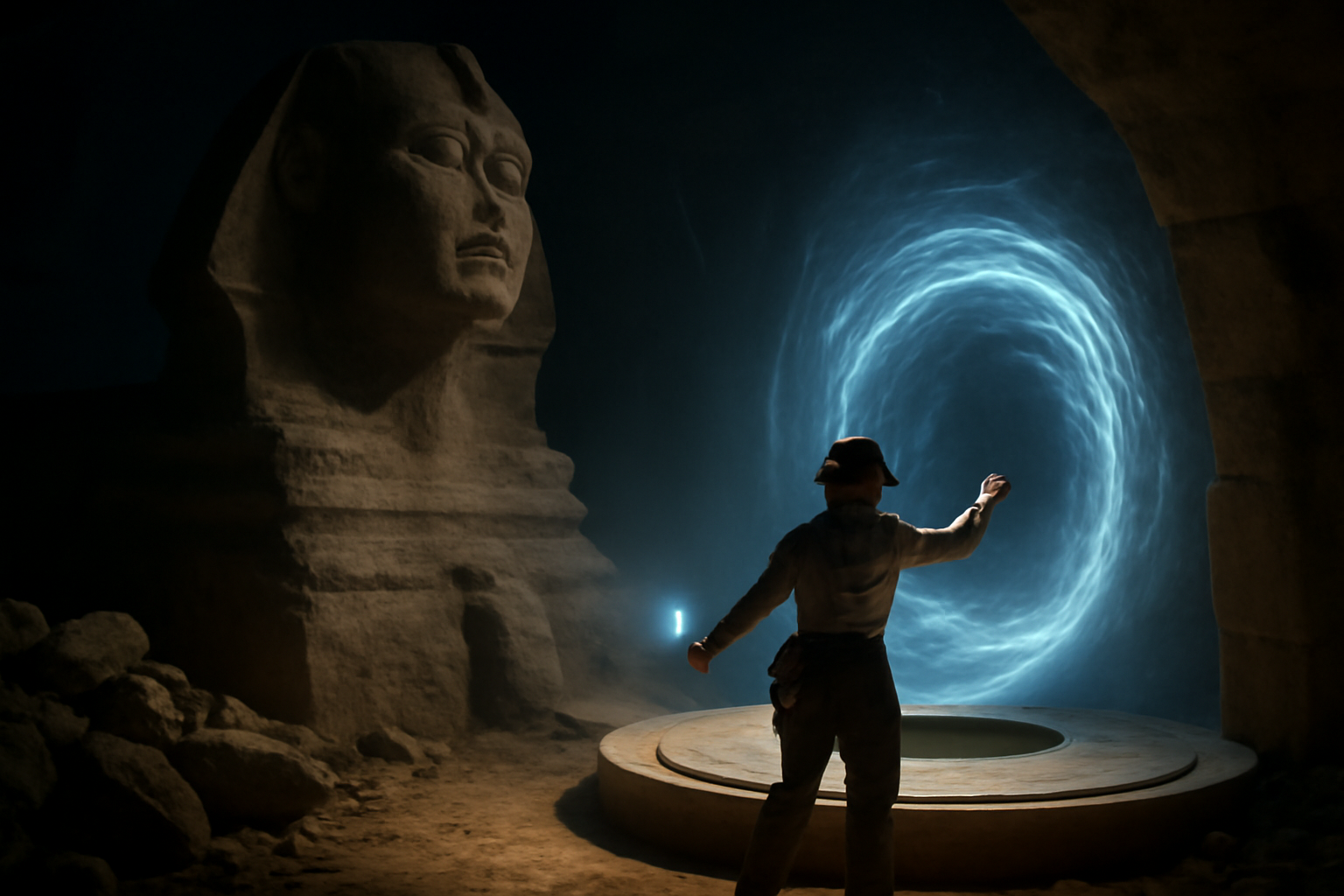
By the time they drilled through the last meter of limestone, the air in the shaft had gone so stale that every breath felt like a mouthful of old paper.
“Reading twenty-one degrees,” called Karim from the sensor console above. “Humidity’s jumping. You’re almost in.”
Dr. Noor El-Sayed wiped the sweat from her eyes with the back of her wrist and tightened her grip on the rope. The harness dug into her hips as she lowered herself the final few meters down the narrow borehole carved between the Sphinx’s paws.
The world narrowed to three things: the beam of her headlamp, the drum of her own heartbeat, and the faint, metallic vibration that had been growing stronger the deeper they went.
It sounded nothing like shifting rock.
“Two meters,” Karim’s voice crackled through the headset. “Then you’ll hit the anomaly.”
The anomaly.
For decades, ground-penetrating radar had hinted at cavities beneath the Giza plateau. Most turned out to be natural voids, collapsed tunnels, unfinished construction. But this signal—this one had been different from the start. A clean rectangle. Perfectly level. Absorbing radar waves like a sponge.
And—most troubling of all—it vibrated.
“Almost there,” Noor whispered.
Her boots bumped against the bottom of the shaft. Her headlamp swept across rough stone, dust, and—
A seam.
A hairline crack in the rock, running in a perfect straight line.
“Noor?” Karim asked. “Talk to me.”
“I’m standing on it,” she said. “The ceiling of the chamber.” She crouched, brushed away the dust, and saw the faint outline of a slab cut with inhuman precision.
Her chisel felt like a toy against it. But the stone wasn’t as thick as it looked. One hard strike, then another, and the slab shifted with a faint clunk. A breath of cold air brushed her face.
She froze.
Cold.
Not cool—not underground-stale—but genuinely cold, like air that had never met the Egyptian sun.
“You getting a temp drop?” she asked.
“Yeah,” Karim replied, sounding suddenly alert. “Nineteen… eighteen… Noor, that’s impossible down there.”
“Tell that to the rock,” she muttered.
She wedged the chisel deeper, put her shoulder into it, and shoved. The slab pivoted inward and fell, striking something below with a distant, echoing clang.
Silence followed.
Then a low, steady hum.
Not rock settling.
Not wind.
Something… active.
Noor swallowed. “I’ve got an opening,” she said. “Going in.”
“Copy that. Keep your cam feed live. And Noor?” Karim paused. “If anything looks—wrong—you come back up. Understood?”
“Wrong is why we’re here,” she said, and swung herself through the gap.
She fell farther than she expected—almost three meters—landing hard on a surface that wasn’t stone.
Her knees jolted. Her fingers slapped against something smooth and faintly warm.
The light from her headlamp washed over the chamber.
She forgot how to breathe.
The room was enormous, its ceiling lost in darkness, its floor a seamless plane of black material veined with faint lines of light that pulsed in slow, synchronized waves. The walls curved upward in a gentle arc, studded with hexagonal panels that shimmered like they were holding back water.
“Noor?” Kareem’s voice came, tiny and far away. “We’re not getting your feed.”
She looked down at the camera clipped to her vest. The indicator light had gone dead.
Of course.
“You’ve lost video,” she said. Her voice echoed strangely. “But I’m fine. I’m in some kind of…constructed chamber. No carvings. No sarcophagus. This is not a tomb.”
She walked forward, the lines of light brightening beneath each step like ripples in a pond. The humming underfoot deepened, vibrating up through her boots, into her bones.
At the center of the chamber stood a raised circular platform, waist high and ringed with the same faintly glowing veins. Above it, the air shimmered.
Noor’s skin prickled.
“Describe it,” Karim said.
“Think… metal, but it’s not metal. Like polished obsidian that learned how to conduct electricity.” She paused. “There’s something happening above it. A distortion.”
The deeper she moved into the room, the more the Sphinx above felt like a myth, a mask painted over a face no one had understood.
Every child in Egypt knew the Sphinx’s broken smile. Every tourist had taken a hundred photographs of it. And all this time, beneath its paws, something had been humming in the dark.
“Energy readings just spiked,” Karim said. “What did you touch?”
“Nothing.”
“Then something touched you.”
Her laugh came out thin. “That’s very comforting, thank you.”
She approached the platform.
Up close, the shimmer above it resolved into something stranger: the air itself seemed layered, as if she were looking through stacked sheets of glass, each refracting light at a slightly different angle. The hairs on her arms stood on end.
At the edge of the platform, a small depression waited. A bowl. Just big enough for two hands.
The hum rose a fraction.
“Noor,” Karim said. “Your heart rate’s off the charts.”
“My heart rate was fine until you told me that,” she muttered.
“What do you see now?”
She hesitated. If she described it truthfully, there would be questions. Procedures. Orders to pull back.
She had not come all this way to stop at the door.
“It looks inert,” she lied. “Probably ceremonial. I’ll log the details and take samples.”
She set her gloved hands into the shallow bowl.
The chamber exhaled.
Light pulsed up through the platform, flooding the grooves, racing along the floor toward the walls. The hexagonal panels flared one by one like awakening eyes. The shimmer above the platform thickened into a swirling disc, its surface opaque, its edges razor-sharp.
“Noor!” Karim shouted. “We’ve got an insane EM spike down here—what did you do?”
“I think I turned it on,” she whispered.
Something pulled at her hands—not physically, but conceptually, like gravity aimed sideways. For a heartbeat, her vision split. Half of her still stood in the chamber; the other half stared out over an impossible horizon.
Her eyes saw a city of white stone and silver towers, stretching across a coastline she’d never memorized. Bridges arched over canals of green water. Giant rings floated above the city, humming with blue light.
Then, as quickly as it came, the vision shifted.
Now she stood in a vaulted hall, its ceiling alive with constellations she didn’t know. The air tasted sharper, cleaner. People moved around her—human, but not quite. Taller. Leaner. Dressed in layered fabrics that shimmered like beetle wings. They passed through arches of swirling light as easily as walking through fog.
A woman stepped toward her. Dark hair braided back. Eyes like polished onyx.
“You’re late,” the woman said, her accent strange but understandable. “But at least you made it this time.”
Noor’s throat dried. “Where…where am I?”
“Where you’ve always been supposed to arrive,” the woman said. “At the threshold.”
The humming became a roar. Images flickered faster: a storm rising over an unfamiliar sea, giant machines carved into cliffs, a sky shredded by streaks of fire. Gates—dozens of them—snapping shut as something enormous moved between the stars.
Then she was back.
The chamber beneath the Sphinx trembled. Dust sifted from the unseen ceiling far above. The shimmer over the platform swirled like a storm cloud seen from orbit.
“Noor!” Karim shouted. “We’re reading movement topside—localized seismic event right under the Sphinx!”
The floor lurched. Noor fell to one knee, hands still in the bowl. The platform’s glow intensified, saturating the air with electric light.
She could let go. She knew that instinctively. Pull her hands free, shut this down, climb the rope, send a thousand sterile reports.
Or—
She could see what lay on the other side.
The woman’s voice whispered in her mind, distant but clear: We buried our doors where your kind would worship the surface and ignore the foundations. We hoped you’d be wiser than we were when your turn came.
“What does it lead to?” Noor whispered.
“Not where,” the voice replied. “When.”
The swirling disc above the platform deepened into true black. Not the absence of light, but the presence of somewhere else. Somewhere that pressed against her senses like a crowd behind a locked gate.
“Noor, get out of there!” Karim’s voice cracked. “The Sphinx is— Jesus, the vibrations—”
Stone thundered somewhere overhead.
Noor looked up at the invisible bulk of the Sphinx, imagined it as nothing more than a camouflage shell covering a device built before the first dynasties, before humans had carved so much as a mud brick.
“What did you hide from?” she whispered to the vanished woman. “What was so bad you locked it behind time?”
The answer came not in words but in sensation: a pressure, vast and cold, moving between the stars like a tide. Something that noticed light the way sharks noticed blood.
“We were loud,” the voice said. “We lit beacons across the sky. We believed we were alone.”
The disc of darkness above the platform rippled. Briefly, terrifyingly, Noor saw an image: the Sphinx as it might once have been—whole, painted, pristine—and behind it, gateways arcing open along the horizon, dozens of them, each a tunnel through time.
Then fire.
Collapse.
Silence.
They had shut themselves away to be forgotten.
Noor realized her hands were shaking. “If I step through,” she asked, “can I come back?”
“That depends,” the voice said gently, “on whether you still want to.”
Stone cracked.
The rope swayed somewhere above her, useless now.
“Noor!” Karim shouted. “The paws are fracturing—we have to evacuate the plateau! You have to move!”
She looked at the swirling void. At the glowing veins running beneath her feet. At the device that had slept through the rise and fall of empires, waiting for someone reckless enough, curious enough, desperate enough to activate it.
Every textbook she’d ever studied had told the story of ancient Egypt as a closed chapter, a past to be cataloged, dusted, displayed.
But this wasn’t a chapter.
This was a hinge.
Noor took a breath.
“Tell them,” she said into her headset, “that the Sphinx wasn’t built to guard a pharaoh’s pride.”
“What?” Karim asked. “What are you talking about?”
“It’s guarding a door,” she said. “And I’m going to see where it leads.”
She stepped onto the platform.
The hum became a scream of light.
Then the chamber was empty.
The tremors topside would be blamed on natural subsidence. The crack in the Sphinx’s paw would be patched and painted. The shaft would be sealed under the watchful eyes of a dozen ministries.
Noor’s rope would be found, dangling uselessly into darkness.
People would argue for years about what she might have discovered.
None of them would suspect that somewhere, in a city of white stone lit by unfamiliar stars, Noor El-Sayed stepped out of a ring of swirling light and into a past that had been waiting a very long time to be remembered.